

For decades, fixed deposits (FDs) have been the comfort zone of Indian savers. They’re where families park savings for weddings, education, or retirement. But, occasionally, some incidents serve as a reminder that even banks can stumble.
Do you recall the crisis at the Punjab & Maharashtra Cooperative Bank, where careless lending left depositors stranded? Or when customers were abruptly subject to stringent withdrawal limits after YES Bank had to be rescued in 2020? Moments like these raise an uncomfortable question: If banks can fail, how safe are our FDs really?
That’s where FD insurance comes into the picture. It doesn’t prevent crises, but it acts like a safety net when banks stumble, ensuring that depositors don’t lose everything they worked so hard to save.
Let us understand FD insurance in detail.
Why Do We Trust Fixed Deposits So Much?
FDs carry several advantages that make them appealing for conservative investors:
- The financial institution promises a fixed interest rate for a predefined term.
- Barring bank failure or regulatory intervention, you are almost certain to recover your principal plus interest.
- The exact timing of your interest or maturity payout is determined by the payout option.
- The Reserve Bank of India (RBI) oversees bank regulation, and depositors are protected by laws, including insurance.
The Hidden Risks Behind FDs
No investment is entirely without risk. Here are some potential pitfalls with FDs:
- If a bank becomes insolvent, unable to fulfil its obligations, depositors may face delays, loss of part of their funds, or legal complications.
- The interest rate might be lower than inflation, reducing the real value of returns.
- Premature withdrawals often attract penalties, lowering your effective return.
- If interest rates rise, money locked in an older FD at a lower interest rate incurs an opportunity cost.
Hence, it’s reassuring to know that there is a formal mechanism that insures deposits in many banks, namely, FD insurance.
What is FD Insurance?
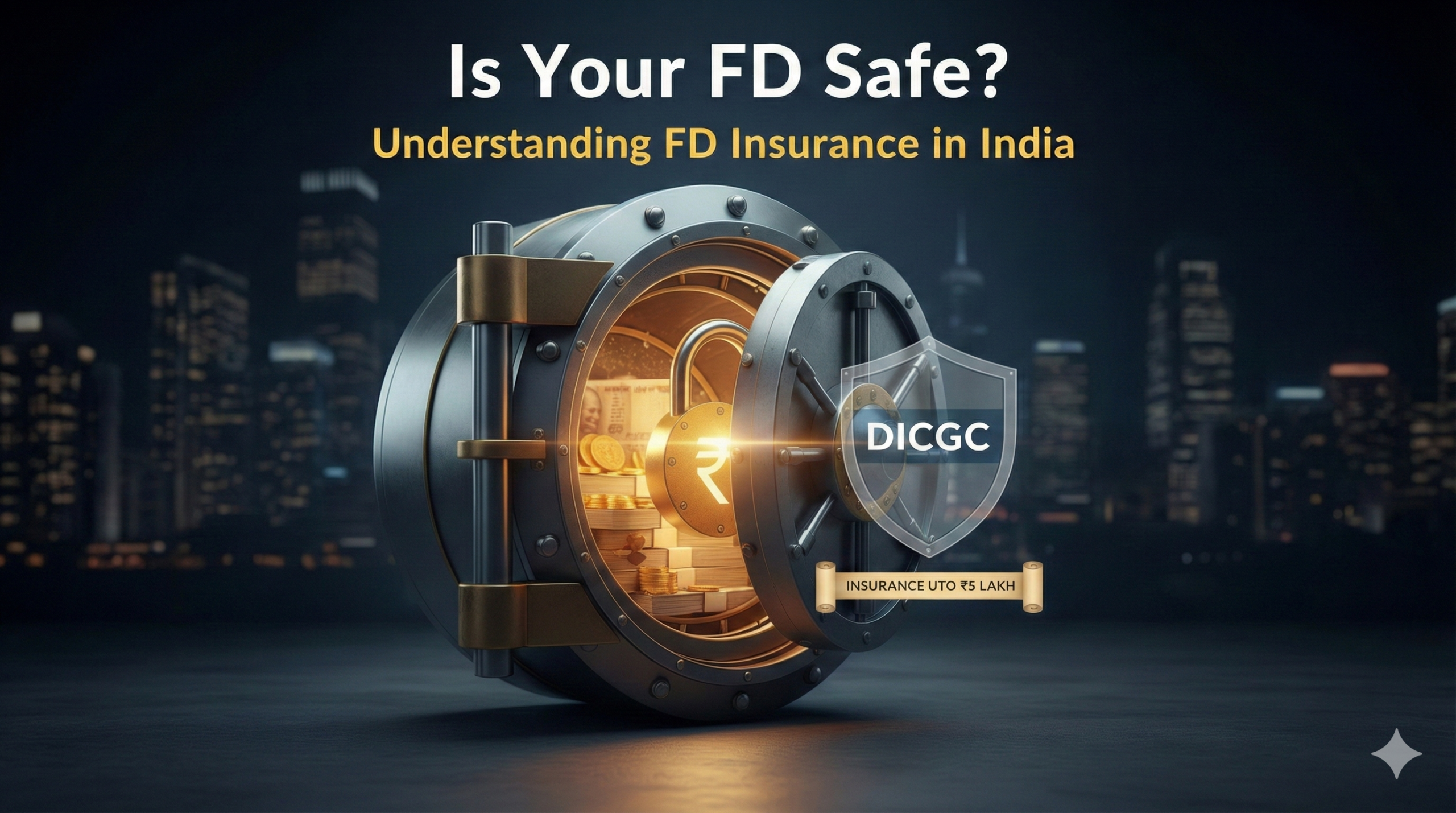
FD insurance refers to the protection provided for deposits (including fixed deposits) by an insurer in case the bank fails. In India, this is handled by the Deposit Insurance and Credit Guarantee Corporation (DICGC), a subsidiary of the RBI. The FD insurance limit is up to ₹5 lakh per depositor per bank.
It is not an optional add-on; nearly all commercial banks and many cooperative banks are automatically covered. It aims to protect depositors up to a certain amount, including interest.
The Role of DICGC
Here are a few things to know about the role of DICGC.
Which Banks are Covered by DICGC?
- All commercial banks in India are covered. This includes public sector banks, private banks, foreign bank branches operating in India, local area banks, and regional rural banks.
- All cooperative banks are also insured (state co-op banks, central, and primary co-op banks), provided they are registered under the DICGC scheme.
- Primary cooperative societies are not insured.
What Does the DICGC Insure?
All types of deposits, such as savings, fixed, recurring, and current, are insured. So your FD is included. The insurance covers both principal and interest (accrued interest up to the date of failure) up to a maximum limit of up to ₹5 lakh per depositor per bank.
But not all deposits qualify for this protection. Exclusions include deposits held by foreign governments, central or state governments, other banks, deposits placed outside India, and certain funds exempted explicitly by the RBI.
When Is DICGC Liable To Pay Insurance?
- If a bank shuts down, DICGC pays the liquidator up to ₹5 lakh per depositor within two months from the date of receipt of the claim list. After that, the liquidator distributes the money.
- If a bank is merged or reconstructed, DICGC pays the shortfall (up to the FD insurance limit of ₹5 lakh) to the new or restructured bank, which then credits depositors.
- If RBI restricts a bank and depositors can’t access their money, DICGC also steps in to cover eligible claims under its rules.
What Is Covered & What Is Not?
Understanding the limits and exclusions is critical.
What’s Covered
- FDs are covered, along with other deposits (savings, recurrent, and current), in insured banks.
- Both principal and accrued interest are covered up to the limit.
What’s Not Covered
- Deposits raised by NBFCs (Non-Banking Financial Companies)
- Deposits with Land Development Banks
- Investments in mutual funds
- Stocks and bonds
- Exchange Traded Funds (ETFs)
- Cryptocurrencies
How Does FD Insurance Actually Work?
Let’s walk through how the system works in practice:
- You open an FD in a DICGC-insured bank. You don’t have to do anything extra; coverage is automatic.
- Maintain records of the deposit amount, interest rate, and accruals. You should ensure you have a receipt or account statements.
- If the bank defaults or is liquidated, depositors do not need to apply for insurance in advance; DICGC steps in.
- DICGC assesses the amount due (principal + interest up to the failure date), applies the insurance cap, and pays you the insured amount. There may be delays depending on the legal/liquidation process.
Ways to Keep Your FDs Truly Safe
Here are practical things you, as a depositor, can do to maximise safety.
1. Choose a reliable bank
Always confirm that the bank where you are placing an FD is reliable and trustworthy. You can read reviews and testimonials online.
2. Split FDs if needed to stay within the insured limit
If you have, say, ₹10 lakh to invest with a single bank, consider splitting across different banks or in different names/capacities so that each chunk is within the ₹5 lakh insured limit.
3. Keep good documentation
Retain fixed deposit receipts, bank statements, and interest calculation slips. In case of bank failure, your records will help in validating the insured amount.
4. Check beneficiary/joint status details
If you have joint accounts, make sure the details are correct and consistent, so insurance claims are not delayed or contested.
Final Word
Fixed deposits are still one of the safest and most trusted investment options for Indians. But as the PMC and YES Bank episodes showed, even banks can run into trouble. That’s why FD insurance matters. It makes sure you don’t lose everything if the unexpected happens.
Remember the ₹5 lakh cap, spread your money out among different banks if you need to, and always double verify to make sure your bank is DICGC-insured. Your FDs can stay as safe and reliable as you expect them to be if you know what to look out for.
FD insurance is automatic; you don’t need to apply for it. If your bank fails, the DICGC will step in and repay up to ₹5 lakh per depositor, per bank.
The biggest limitation is the ₹5 lakh cap, which may not fully cover large deposits. Also, in case of bank liquidation, payouts can take time depending on the legal process.
The biggest limitation is the ₹5 lakh cap, which may not fully cover large deposits. Also, in case of bank liquidation, payouts can take time depending on the legal process.
Currently, deposits up to ₹5 lakh (principal + interest together) are insured with each bank. If you hold more than this in one bank, the excess amount is not covered.
FDs are considered very safe, but not completely risk-free. Anything above the ₹5 lakh insurance limit carries risk. Also, insured payouts may face delays if the bank undergoes restructuring.